EUDR benchmarking system: risk categories and obligations in 2026

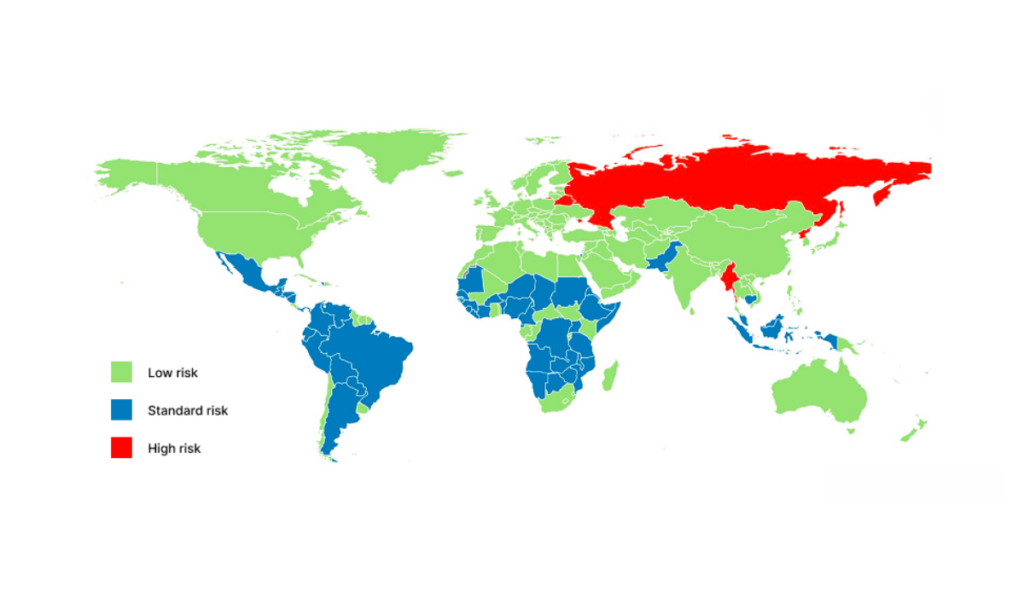
The benchmarking system of the EU Deforestation Regulation is a central instrument for assessing countries of origin. It classifies countries into three risk categories: low risk, standard risk and high risk. This classification directly determines the scope of due diligence obligations and how frequently authorities carry out inspections.
Low risk
Imports from low-risk countries benefit from simplified due diligence under Art. 13 EUDR. Products from these countries must still meet the extensive information requirements (Art. 9 EUDR), but no risk analyses (Art. 10 EUDR) or risk mitigation measures (Art. 11 EUDR) are required. That reduces the administrative burden but changes nothing about the fundamental duty to provide evidence: exact geocoordinates of the plots of production must still be captured. The inspection rate is 1%.
Standard risk
The standard-risk category is the default case and carries the full due diligence requirements. Companies must capture the exact geographic coordinates of the plots of production, perform a risk analysis, and implement mitigation measures where needed. The inspection rate is 3%.
High risk
Countries in the high-risk category are also subject to the full due diligence requirements. Because of the high deforestation risk or breaches of local law, companies need to look particularly closely here. The inspection rate is 9%.
Why the benchmarking matters
The risk classification has a direct impact on the effort, cost and speed of EUDR compliance. Imports from high-risk areas demand more time and resources, while imports from low-risk areas offer an administrative advantage. Companies that analyse and adapt their supply chains early meet the requirements more efficiently and minimise the risk of delays.
Important: even though no risk analysis is required for products from low-risk countries, Art. 9 EUDR still requires collecting comprehensive information on the basis of which a risk analysis would be possible. It would therefore be wrong to assume that companies sourcing from low-risk countries can postpone collecting the relevant information.
Polygon One supports companies through every step of EUDR implementation, from origin analysis and risk assessment through geolocation to integration with the EU's TRACES system.

Let's
talk.
A no-obligation 30-minute call. We’ll show you the platform, listen to how your supply chain works, and put together a transparent quote.
Or email us directly: a.ruetjes@polygon-one.com
The booking calendar is loaded from HubSpot (Ireland) and sets cookies. It appears once you allow external content.